Photo by Immo Wegmann on Unsplash
Can Fingerprints Go on Everything? A Kid Detective’s Guide
by Dr. Jennifer Hall Rivera on Sep 23, 2026
Welcome back to the “Ask a Forensic Scientist” blog! Sarah G. (age 12) asks,
“I like investigations. They are interesting. Can fingerprints go on everything? If so, how do they get the prints without damaging them?”
You sound like a real detective, Sarah! What a great question. Let’s look at God’s design in our fingerprints and see how it testifies to Psalm 139:14, where we read, “I am fearfully and wonderfully made.”
What’s Actually on Your Fingertip?
The skin on the surface of our hands and feet is called friction ridge skin. God designed this skin with raised ridges that roll up and down like mountains and valleys. Scientists call it “friction ridge” skin because it helps us get a firmer grip, like the tread on a tire or ridges on your sneakers.
Fingerprints fall into one of three pattern types: loops, whorls, and arches. But within those three types, there are tiny details called minutiae. It’s the arrangement of these tiny details that makes each pattern unique to every person, down to every finger, toe, palm, and sole of the foot.
The Sweat Connection: God’s Engineering
The mountain peaks of friction ridge skin are lined with tiny sweat pores, arranged in a single file. You secrete sweat from these pores all the time. You can’t stop yourself from sweating! Chemical analysis of sweat shows that it’s made up of water, salts, and oils.
When you touch something, some of that sweat residue transfers onto the surface. The result is a fingerprint. Think of it like a built-in ink pad that stamps your unique signature on almost everything you touch.
Can Prints Go on Everything?
The answer is: not quite everything. You do leave your DNA on nearly everything you touch, since it’s present in your perspiration, but the detailed pattern of your friction ridge skin doesn’t always transfer. Factors like the type of surface and the amount of oil in the sweat residue affect the result.
- Nonporous, smooth surfaces (like glass, metal, and plastic) tend to hold and reveal fingerprints very well.
- Rough surfaces can be a real challenge for forensic scientists.
- Porous surfaces, like paper and parchment, absorb fingerprint oils and can hold that information for hundreds of years.
- Textured surfaces, like unfinished wood, concrete, or fabric, don’t easily let fingerprint details stick, which makes them tricky to work with.
Every fingerprint left on these surfaces is either latent (invisible), patent (visible), or plastic (impressed into a soft material).
How Investigators Lift Prints Without Damage
The method investigators use to lift and preserve a fingerprint depends on the type of fingerprint: latent, patent, or plastic.
Latent fingerprints: Crime scene investigators use several techniques to protect, lift, and preserve these invisible prints. These are just a few:
- Dust-Tape-Lift: This method doesn’t damage the evidence. Powder is brushed onto the surface, where it sticks to the oils left behind after the water in perspiration evaporates. Tape is then used to lift the dusted print and preserve it on a backer card.
- Magna-powder is a common version of this technique. A magnetic wand brushes the surface with finely ground iron filings, which stick to the fingerprint residue and reveal the pattern.

Forensic scientists developing a latent fingerprint with a magna brush, which is used in the magnetic powders method.
Photo by Daekow (Wikimedia Commons, CC BY-SA 4.0).
- Magna-powder is a common version of this technique. A magnetic wand brushes the surface with finely ground iron filings, which stick to the fingerprint residue and reveal the pattern.
- Fuming: Evidence is placed in a sealed cabinet where chemical fumes react with the print.
- Iodine fuming is the oldest method, used mainly on porous surfaces like paper. Iodine crystals release fumes that react with the fatty acids in sweat, turning the fingerprint a mustard-brown color.
- Superglue fuming works well for hard-to-see prints on nonporous surfaces. As heated superglue releases fumes, they crystallize on the fingerprint residue, revealing a white print. These prints are quite durable and can even be dusted and lifted multiple times.
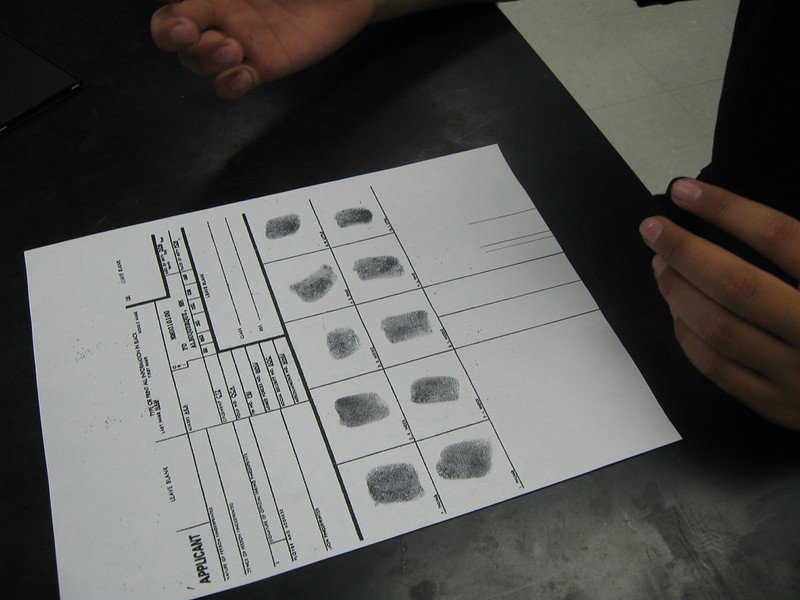
Photo by Citizen Schools Photos, CC BY-SA 2.0, via Flickr
- Lighting: Sometimes, no powders or chemicals are needed at all.
- UV short-range light reflects off or absorbs fingerprint residue, which can then be captured with specialized cameras.
- Alternate light source (ALS) devices use lasers to emit different wavelengths of light, with filters that help reveal prints that are otherwise hard to see.
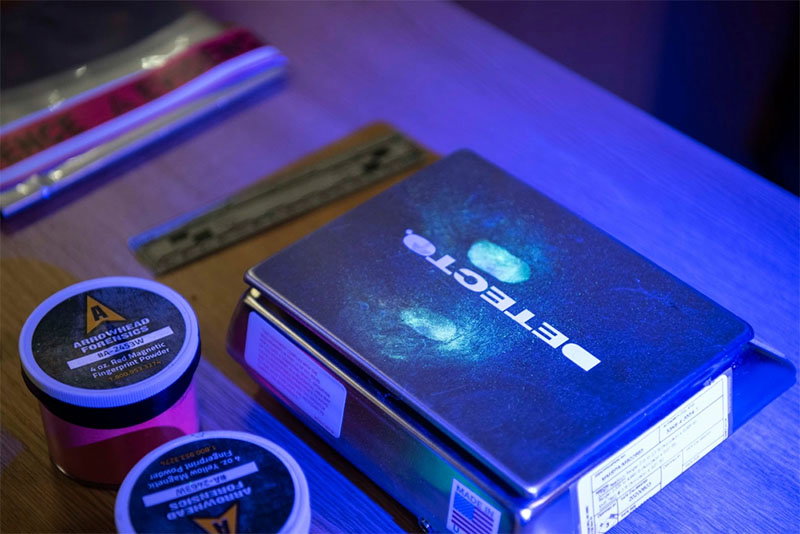
Patent fingerprints: Since these are already visible, the best way to preserve them is simply through photography.
Plastic fingerprints: Casting is used to preserve these impressions. Plaster is poured into the impression, allowed to harden, then carefully removed and taken to the lab for examination.
A Tiny Signature
Every fingerprint, whether seen or unseen, is a tiny signature from a Creator who designed you fearfully and wonderfully. God designed our perspiration to secrete specific oils that interact with different chemicals. His order throughout creation allows investigators to use scientific methods to uncover hidden clues. Next time you touch something, remember: God made you one-of-a-kind, on purpose, to reflect His glory.
Do you have a question about forensics or how forensic scientists pursue God’s desire for justice? Ask your parents to help you submit your question today!
For more like this, ask your parent to help you check out Dr. Rivera’s textbook, Intro to Forensic Science: From a Biblical Worldview, for grades 11–12, and her books for ages 8–13: DNA, God, & You! and The Work of Your Hand.
Read More Articles
Do Insects Have Fingerprints?
